
Sapphire FUE Hair Transplant Antalya Turkey
Antalya has quietly become one of the most technically advanced destinations in the world for hair restoration. While Istanbul often dominates the conversation, clinics in Antalya have been at the forefront of adopting precision-based techniques — and Sapphire FUE is one of the clearest examples of that shift.
If you have been researching hair transplant options and keep coming across the term “Sapphire FUE,” this guide explains exactly what it means, why the blade material matters more than most patients realise, and why Antalya has become a preferred destination for patients seeking this specific technique.
WHAT IS SAPPHIRE FUE HAIR TRANSPLANT?
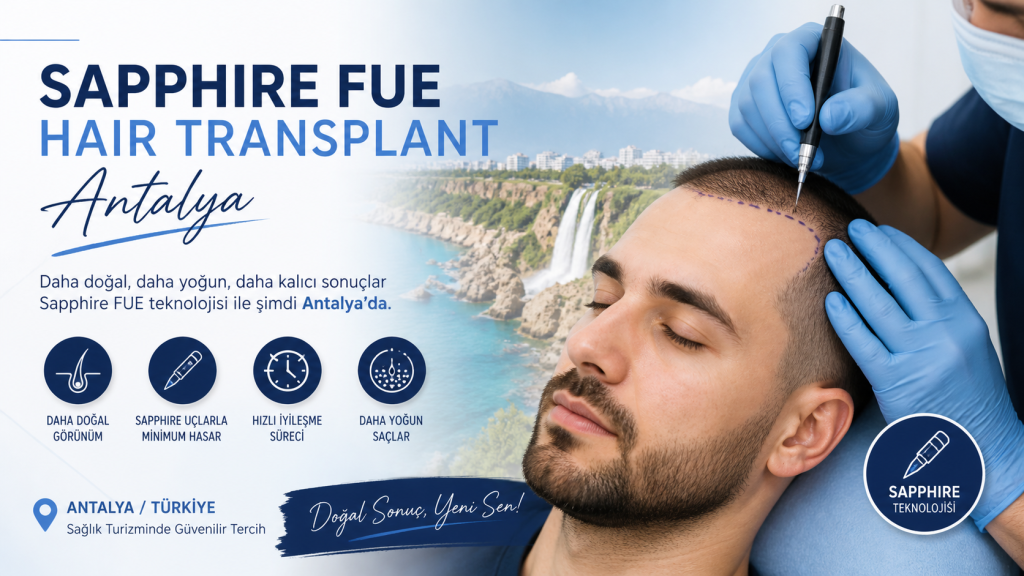
Sapphire FUE is an advanced form of Follicular Unit Extraction. The procedure follows the same core principles as standard FUE — individual hair follicles are extracted from the donor area at the back of the scalp and implanted into areas experiencing thinning or hair loss — but with one significant difference: the incisions made in the recipient area are created using blades crafted from natural sapphire gemstone rather than standard steel.
That single change in material has a measurable impact on the precision, healing speed, and overall quality of results that patients experience.
WHY DOES THE BLADE MATERIAL MATTER?
Standard steel blades, even high-quality surgical ones, have a slightly rougher surface at a microscopic level. Sapphire, by contrast, is one of the hardest natural materials on earth and can be shaped to an exceptionally fine, smooth tip. When these blades are used to create the channels into which grafts are placed, the result is:
Smaller, more precise incisions that match the natural diameter of hair follicles more accurately. This means less tissue trauma during the procedure.
Smoother channel walls that allow grafts to sit more securely, reducing the risk of displacement during the critical first days after surgery.
Faster tissue recovery because the surrounding scalp cells experience less disruption. Patients typically notice reduced redness and scabbing compared to standard FUE.
Lower infection risk due to the anti-bacterial properties of the sapphire surface, which creates a less hospitable environment for bacterial adhesion compared to metal.
Higher graft survival rates, which directly translates into denser, more natural-looking results. This is the outcome metric that matters most to patients.
HOW IS SAPPHIRE FUE PERFORMED IN ANTALYA?
The procedural flow at established clinics in Antalya follows a structured three-day journey, which has become the standard framework for international patients.
On arrival day, patients undergo a detailed consultation and hair analysis. The medical team assesses the degree of hair loss using the Norwood Scale, evaluates donor area density, calculates the number of grafts required, and designs the hairline together with the patient. This planning stage is taken seriously in Antalya — precision at this point determines the quality of everything that follows.
On the procedure day, local anaesthesia is applied to both the donor and recipient areas. Extraction is performed using micro-punch tools calibrated to the individual follicle diameter. The sapphire blades are then used to open the channels in the recipient area at angles carefully matched to the patient’s natural hair direction. Grafts are implanted one by one. Depending on the number of grafts required, the full session typically takes between six and eight hours.
On the third day, the first professional hair wash is performed at the clinic. The medical team checks graft placement, reviews healing progress, and provides the patient with a detailed aftercare protocol before departure.

SAPPHIRE FUE VS STANDARD FUE — KEY DIFFERENCES
Both techniques achieve hair restoration, but the differences become apparent in the density of results and the recovery experience.
With standard FUE, recovery involves a predictable period of redness, swelling, and scabbing. Results are good in the hands of an experienced surgeon. However, the blade profile of steel tools limits the minimum channel size that can be achieved, which places a ceiling on how densely grafts can be packed in a given area.
With Sapphire FUE, the finer blade tip allows channels to be opened closer together without damaging neighbouring follicles. This increased channel density means more grafts can be placed in the same surface area, producing noticeably fuller results from a single session. For patients with moderate to advanced hair loss, this distinction is particularly significant.
The recovery timeline is also shortened. The smoother incision profile means the scalp responds with less inflammation, and most Sapphire FUE patients in Antalya report that visible redness clears faster than they expected.
SAPPHIRE FUE VS DHI — WHICH IS RIGHT FOR YOU?
This is one of the most common questions at any Antalya hair transplant consultation, and the honest answer is that the right technique depends on your specific pattern of hair loss.
Sapphire FUE is generally the preferred choice when a large number of grafts are needed in a single session — typically 3,000 grafts or more. It is also highly effective for patients with advanced hair loss across the crown and mid-scalp, where broader coverage is the primary goal.
DHI, which uses a Choi Implanter Pen to extract and implant in a single motion, is often preferred for hairline refinement, adding density to areas that still retain some existing hair, and for patients who want to avoid shaving the recipient area entirely. DHI is precise but slower per graft, which makes very large sessions less practical under it.
In practice, many experienced clinics in Antalya combine both approaches — using Sapphire FUE for the main coverage areas and DHI for hairline detailing — to give patients the benefits of each technique in a single procedure.
WHO IS A GOOD CANDIDATE FOR SAPPHIRE FUE IN ANTALYA?
Sapphire FUE is suitable for most adult men and women experiencing androgenetic alopecia, traction alopecia, or hair loss following scarring. A good candidate will have a stable donor area with sufficient healthy follicle density, realistic expectations about the outcome, and no underlying medical conditions that would contraindicate surgery under local anaesthesia.
Patients who are not yet at a stable phase of hair loss — particularly younger patients where the pattern is still progressing — are typically advised to wait, or to plan their restoration in staged sessions to accommodate future changes.
A thorough pre-operative assessment at any reputable Antalya clinic will identify whether Sapphire FUE is the most appropriate path for your specific case.
RESULTS — WHAT TO EXPECT AND WHEN
Hair transplant results follow a predictable biological timeline regardless of the technique used.
In the first two to three weeks, the transplanted hairs enter a shedding phase known as shock loss. This is entirely normal and expected. The follicles themselves remain anchored beneath the scalp and are not lost.
Between months two and four, early regrowth begins. The emerging hairs are initially fine and may appear different in texture to the surrounding hair. This is temporary.
Between months four and eight, the main visible transformation takes place. Hair becomes progressively thicker and begins to blend naturally with the existing hair.
By month twelve, the majority of patients have achieved their final result. For some patients, particularly those with slower follicle activity, full density continues to improve through to month eighteen.
Sapphire FUE patients in Antalya consistently report high satisfaction at the twelve-month mark, with natural integration being the most frequently cited outcome that exceeded expectations.
RECOVERY AND AFTERCARE FOLLOWING SAPPHIRE FUE
The first ten days after your procedure are the most important. During this period, the transplanted grafts are establishing their blood supply and are vulnerable to physical disruption.
Patients are advised to sleep in an elevated position during the first week to minimise swelling. Direct sunlight to the scalp should be avoided for the first month. Strenuous exercise is paused for two to three weeks. Swimming — particularly in pools and the sea — should wait until the scalp has fully healed, typically around four weeks post-procedure.
Clinics in Antalya provide patients with a care kit including specialist shampoo and lotion for the first wash routine, along with detailed written instructions for the weeks that follow. Most clinics also offer remote follow-up consultations to review progress photographs and answer questions as recovery progresses.
SAPPHIRE FUE HAIR TRANSPLANT ANTALYA COST
Pricing for Sapphire FUE in Antalya is structured around the number of grafts required rather than a flat fee. All-inclusive packages at established clinics typically cover the procedure itself, pre-operative blood tests, local anaesthesia, hotel accommodation, airport transfers, the first professional wash, and a post-operative care kit.
In 2026, Sapphire FUE packages in Antalya for up to 5,000 grafts range from approximately £1,490 to £2,500 depending on the clinic profile and package inclusions. This represents a significant saving compared to equivalent procedures in the United Kingdom, where the same treatment commonly costs between £8,000 and £15,000.
The combination of lower cost, high clinical standards, and Antalya’s established infrastructure for international medical tourism makes it one of the most competitive markets in the world for this procedure.
WHY CHOOSE ANTALYA FOR SAPPHIRE FUE RATHER THAN ISTANBUL?
Both cities offer high-quality options, but Antalya presents several practical advantages that increasingly attract patients who have done thorough research.
Clinic volumes in Antalya are generally lower than Istanbul’s largest facilities. This means more time with the surgical team, less procedural rushing, and a more personalised experience from consultation through to departure.
The city itself is easier to navigate for international patients, with a smaller and more manageable airport, hotels within close distance of clinics, and a relaxed Mediterranean environment that makes the recovery period genuinely pleasant rather than stressful.
Antalya also has over three hundred days of sunshine per year, clean air, and a slower pace than Istanbul — factors that are genuinely relevant when recovering from a surgical procedure.
For patients considering a hair transplant in Antalya who want to explore the full range of techniques and packages available, a free consultation is the logical first step.
FREQUENTLY ASKED QUESTIONS
Is Sapphire FUE painful?
The procedure is performed under local anaesthesia. Patients typically describe the anaesthetic injections as the most uncomfortable part of the experience. Once the anaesthesia takes effect, the procedure itself is not painful. Most patients watch films or listen to music throughout the session.
How many grafts can be transplanted in a single Sapphire FUE session?
In Antalya, experienced clinics routinely complete sessions of 3,000 to 5,000 grafts in a single day. Sessions exceeding 5,000 grafts may be split across two days to protect graft viability.
Does Sapphire FUE leave visible scarring?
The extraction process leaves very small circular marks in the donor area, which become effectively invisible within a few weeks as the surrounding hair grows back. The recipient area channels are so fine that no visible scarring results once the transplanted hair has grown.
Can I combine my Sapphire FUE procedure with a holiday in Antalya?
Many international patients do exactly this. The procedure takes place over the first two days of the visit, and the remaining days can be spent resting and recovering in the city. Given the mild climate and the quality of accommodation available, Antalya is genuinely well-suited to combining a medical procedure with a short break.
How do I know if I am a candidate for Sapphire FUE?
The best way to find out is to submit photographs of your current hair loss pattern and donor area for a free assessment. A qualified hair restoration specialist can advise on suitability, estimated graft count, and the most appropriate technique for your situation.